Table of Contents
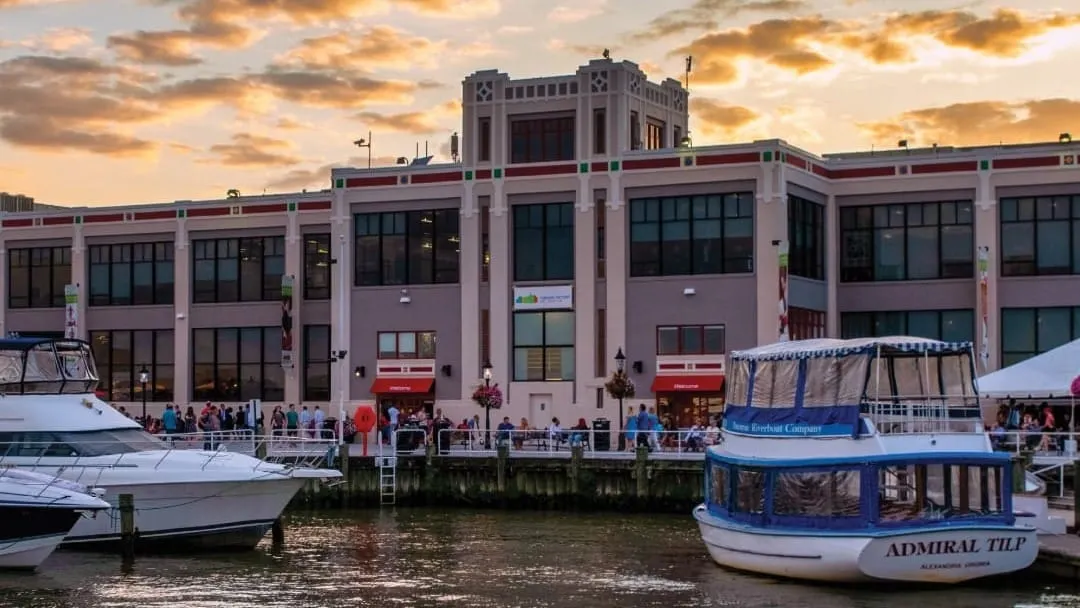
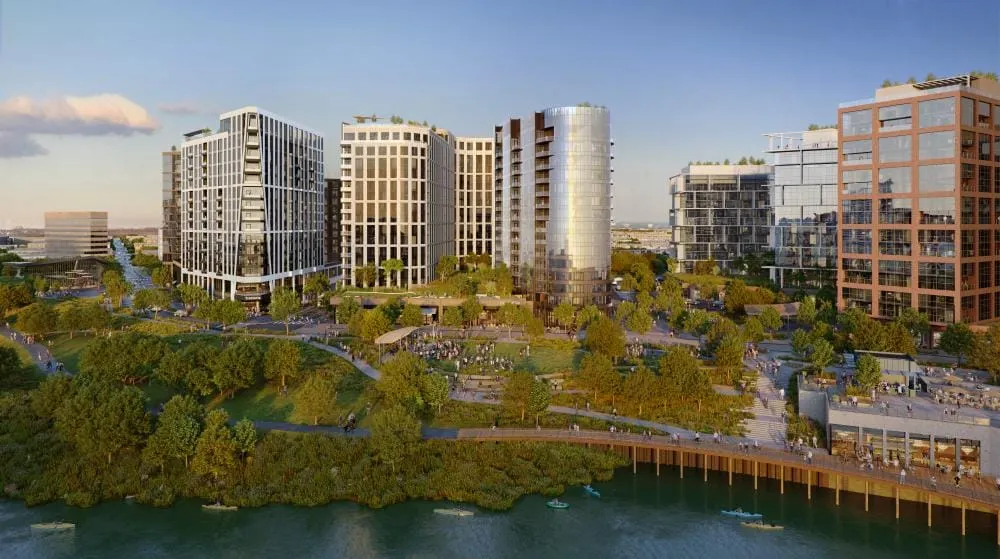
ALEXANDRIA, Va. — The City of Alexandria is considering a request from HRP Group to commit up to $135 million in tax increment financing over roughly 30 years to help redevelop the former Potomac River Generating Station, the 18.87-acre coal-fired power plant site on the Old Town North waterfront that closed in 2012.
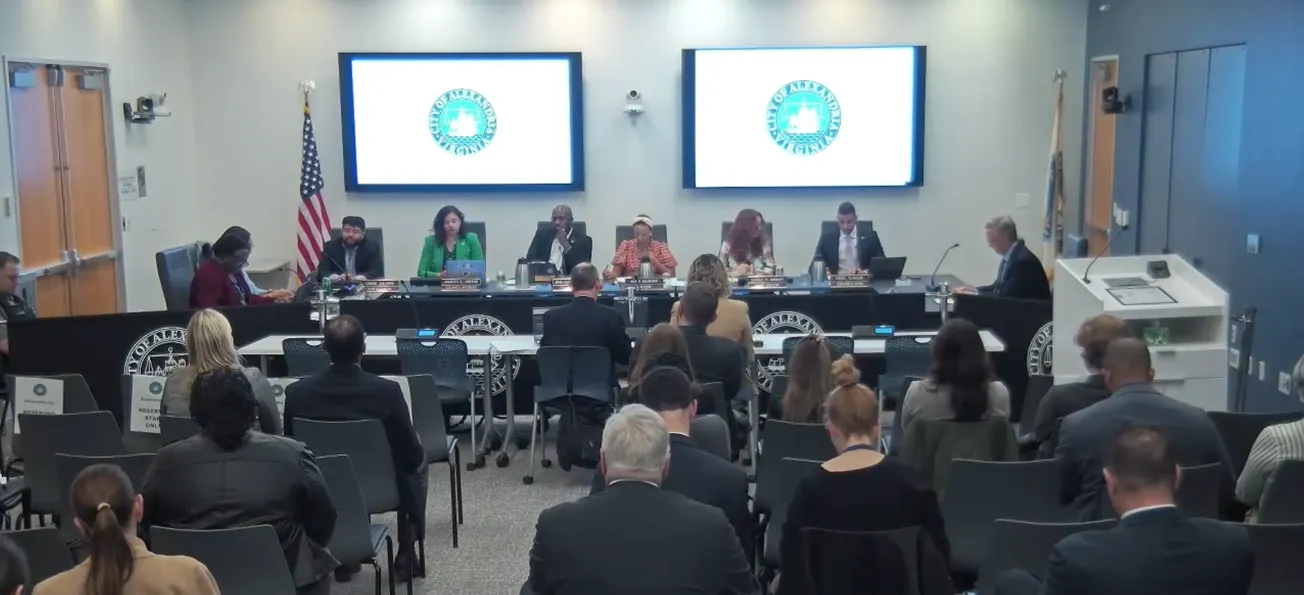
City Manager James Parajon presented the framework Tuesday night to the Alexandria City Council in an oral report, calling the project "one of the largest projects the city has undertaken" and framing the proposal as a way to keep the long-stalled redevelopment moving in a difficult economic climate.
"This is not a new proposal," Parajon told the council. "This project has been with the community for at least the last three to four years, with a series of conversations as well as entitlement processes that city councils have taken action on. And really, what this is about is trying to get this project to construction."
He tied the request directly to the city's broader budget pressures, including the fiscal 2027 spending plan council was set to adopt the following night. "It's dependent upon the ability for revenue to grow in our city. And a big portion of the growth of that revenue is through development growth and property tax growth, really through some of these types of projects."
Tuesday's report was informational. No vote was taken. If the framework holds, council members will be asked on June 13 to authorize the city manager to enter into a development and performance agreement with HRP and to approve Phase I development plans for Blocks B and C, the Waterfront Park, and the Rail Corridor Park. Formation of the Community Development Authority that would issue the bonds would follow in the fall of 2026.
The site and the developer
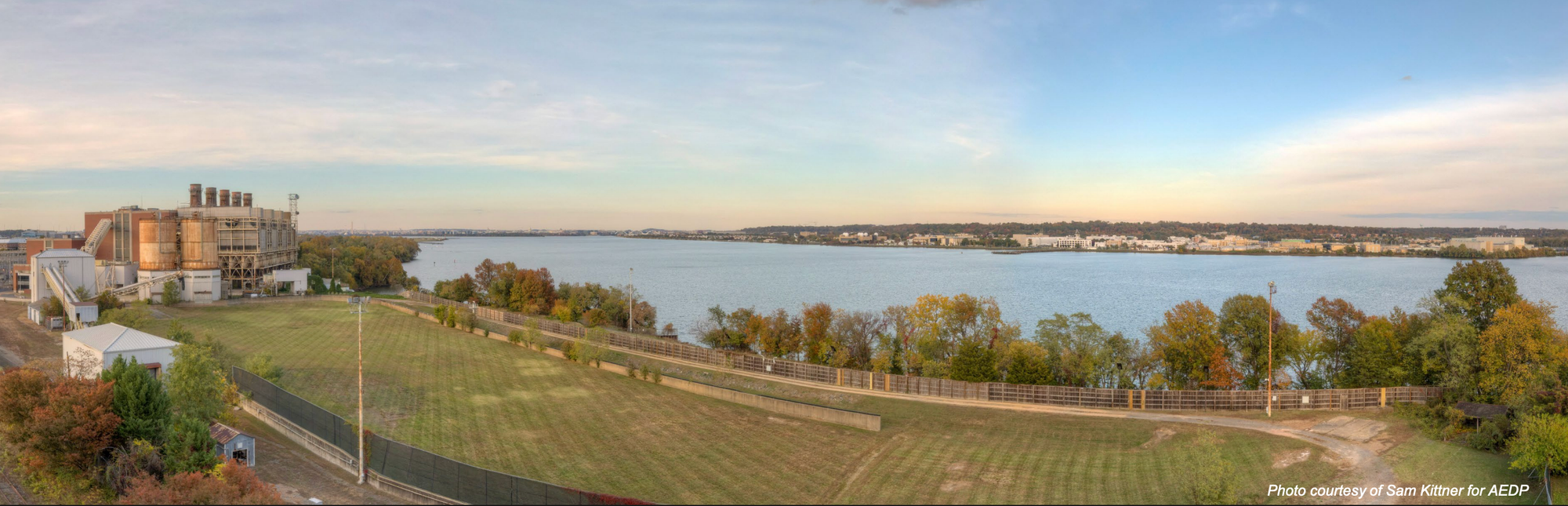
The Potomac River Generating Station operated from 1948 to 2012, supplying power to the Washington region and, for years, ranking as the single largest source of air pollution in Northern Virginia, according to city background materials. The plant's closure followed more than a decade of advocacy by Alexandria residents and city officials concerned about air quality and public health.
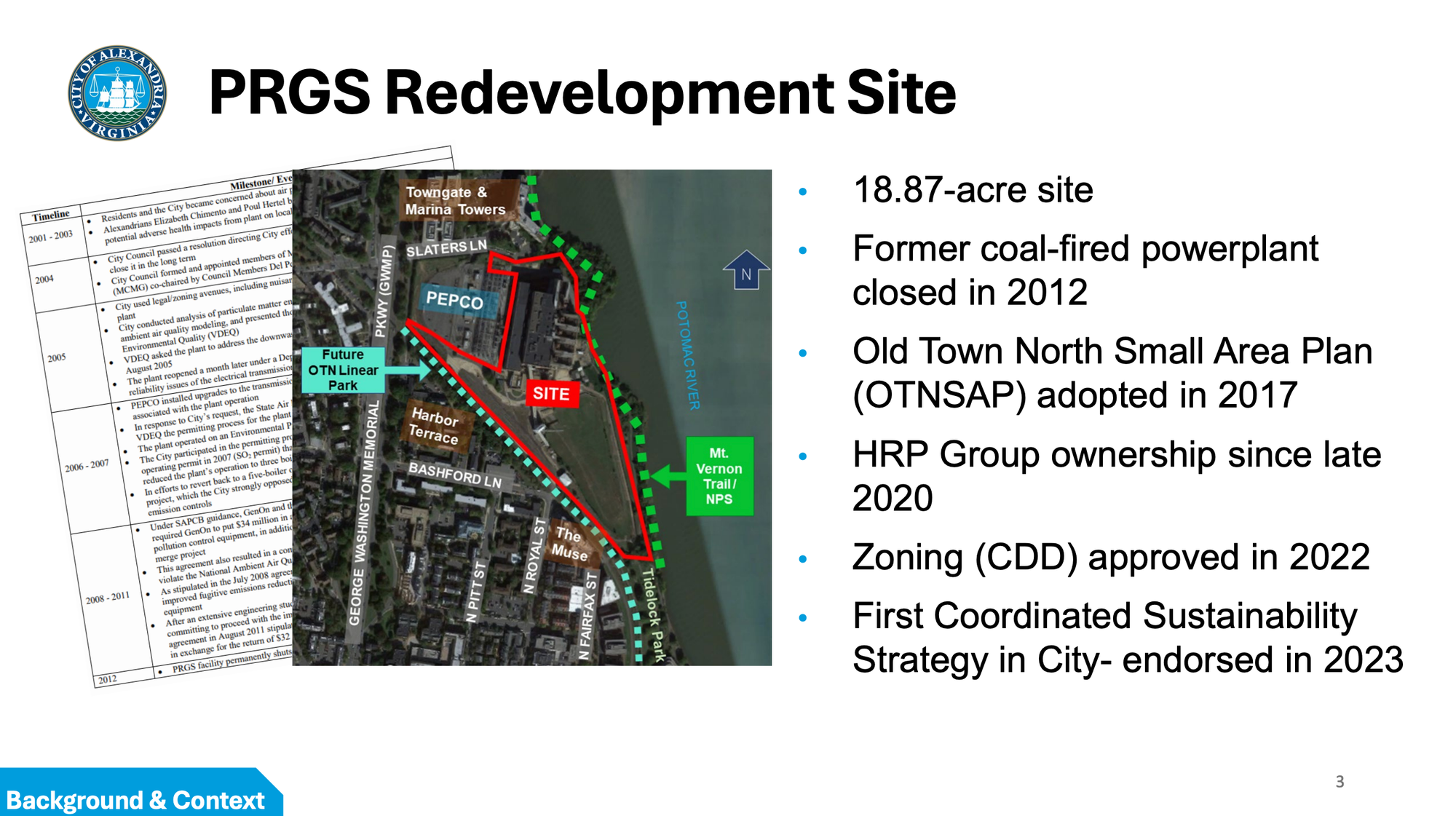
Stephanie Landrum, president and CEO of the Alexandria Economic Development Partnership (AEDP), walked the city council through the site's history. "Our community came together to one, close it down, but two, recognize that this site represents the ability to catalyze a lot of new investment and redevelopment in the Old Town North community," she said. "As part of that 2017 plan, the community envisioned a mixed-use development on the site of what was perhaps the dirtiest operating business in the city."
HRP Group, which purchased the site in late 2020 when it was operating as Hilco Redevelopment Partners, specializes in former industrial sites. The Alexandria project is its fifth coal-plant redevelopment and first mixed-use waterfront community. The site has been inaccessible to the public since the plant's closure.
City Council approved a Coordinated Development District zoning designation and a conceptual design plan in July 2022, following an 18-month community process. The Planning Commission approved an Infrastructure Development Site Plan in June 2023.
Why a subsidy is on the table
Landrum told city council that despite years of work, the site faces a combination of remediation costs, regulatory complexity and weak commercial demand that have prevented the project from advancing without public support.
"We have been working diligently with HRP and our partners to see if there is any other body that would be interested in investing and helping with this cleanup," she said. "Unfortunately, there have been very limited state and federal grants available."
She said the site requires coordination with more outside parties than typical city projects — including the Virginia Department of Environmental Quality, the Federal Aviation Administration because of its location along a flight path, and Norfolk Southern because of adjacent rail lines.
Landrum also pointed to softness in the commercial real estate market. "We have been trying again in earnest to find arts and cultural uses, to find people interested in doing hotel construction and financing, and office tenants. And again, you've heard us many times over recent years. Those things are not very — they're not making investments in many, many places, but they certainly need to be able to move into communities where there's a project underway or where there's investment already happening."
Under the city's Economic Development Investment Decision Matrix, adopted as part of the ALX Forward economic strategy, public investment in private projects is justified only if the project would not proceed without city support. City staff have determined the PRGS proposal meets that "but for" standard.
The proposed deal structure
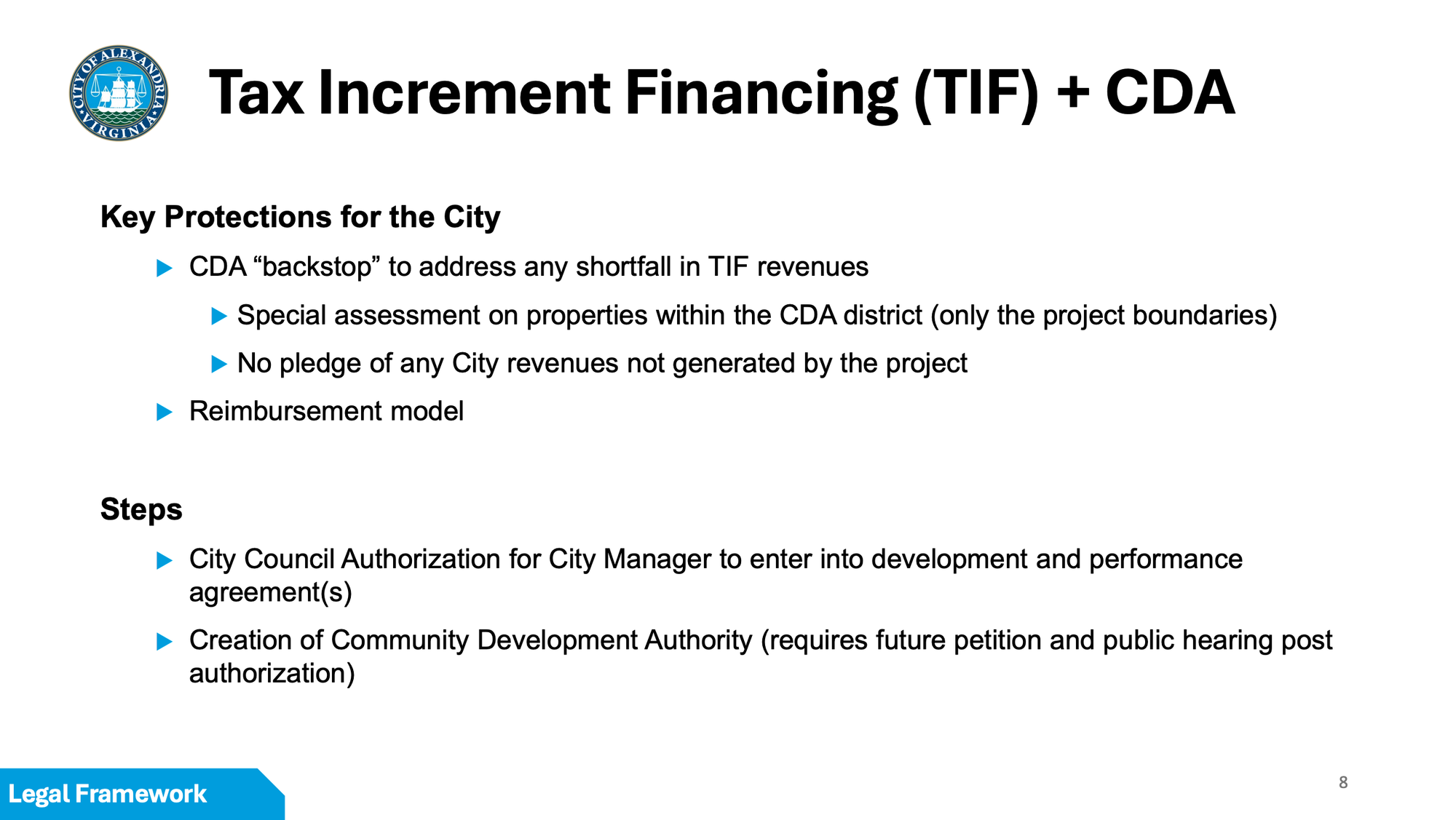
No existing Alexandria tax revenue would pay debt service on the bonds. The TIF would capture only new tax revenue generated by the redevelopment — taxes on buildings, restaurants, retail and hotels that do not currently exist on the site. If the project failed to generate sufficient new revenue, the CDA could levy a special assessment on properties within the project boundaries, but no other Alexandria property would be affected.
The framework calls for the city to facilitate $135 million in net infrastructure proceeds through bonds issued by a newly created Community Development Authority. The bonds would be backed by a portion of new tax revenue generated by the redevelopment, not by the city's full faith and credit.
The $135 million would be disbursed in two phases — up to $70 million for Phase I and up to $65 million for Phase II. The developer would carry the larger share of upfront risk, contributing approximately $110 million in Phase I before any city reimbursement and approximately $45 million in Phase II, for a total developer commitment of roughly $155 million in site readiness costs.
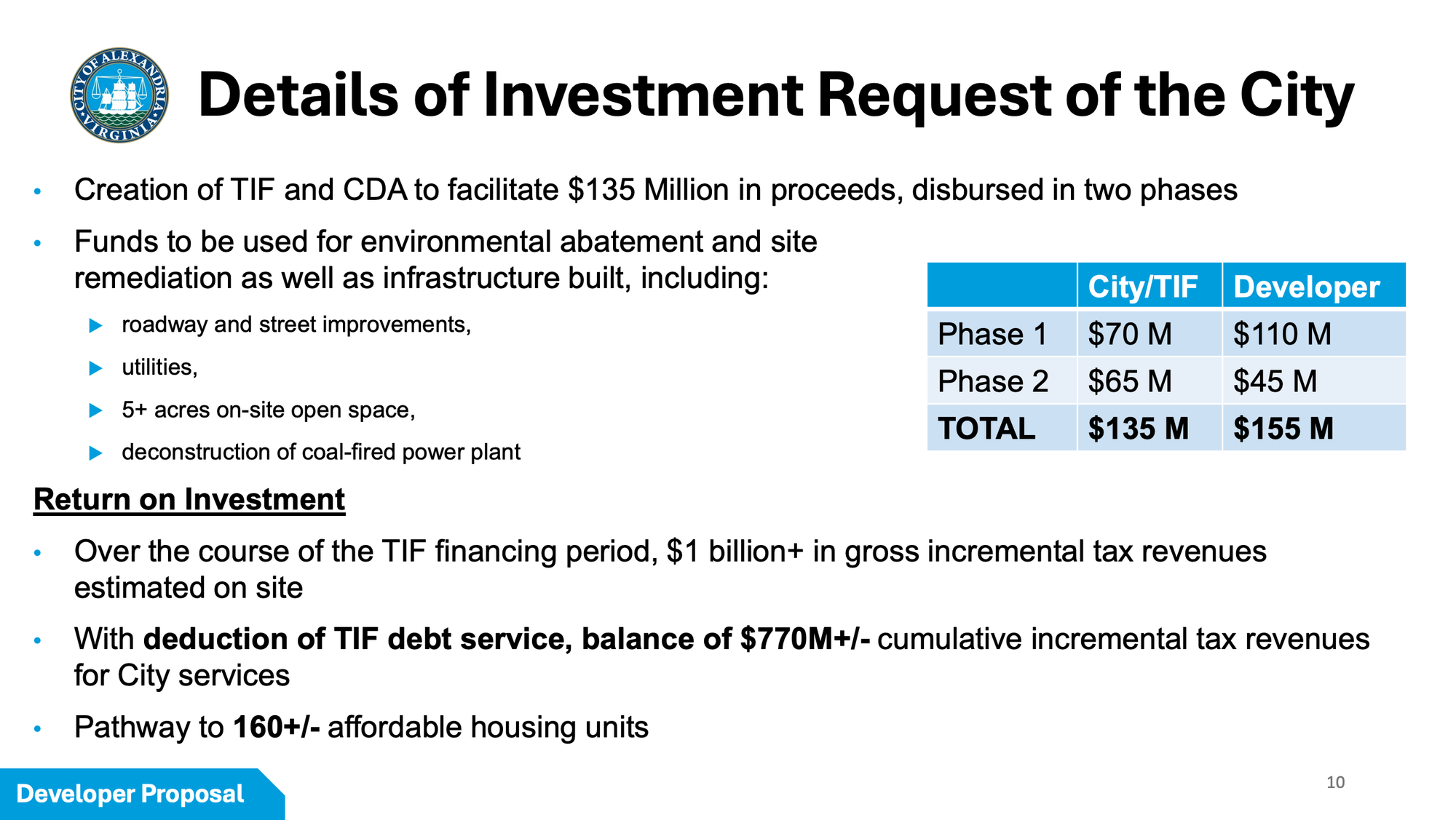
"Their obligation is to provide basically public infrastructure and site readiness investment, which is things like open space, it's the new streets, it's the stormwater," Parajon told city council. "The developer would be responsible for building the infrastructure, not the city. Building the open space, not the city. Demolishing the power plant, not the city. And completing the remediation, again, not the city."
Parajon stressed that the financing structure differs from how the city handled its only previous TIF deal. "This is a little different than in the Landmark redevelopment project. The city actually used general obligation bonds, which means they were backed by existing taxes," he said. "This is not backed by existing taxes, existing revenue. This would be backed by new revenue. And I think that's really important. And this also, this type of tool does not affect our bond rating and does not affect the capacity of our bond issuance."
Deputy City Attorney Bonnie Brown walked the city council through the legal framework. "Tax increment financing allows the city to use future new tax revenues that are generated by a project to fund certain project costs," Brown said. "Importantly, we're going to define those tax sources in the agreements. They'll be limited to only certain tax sources and no existing city revenues will be used. So the concept is pretty straightforward. If approved, the project would help pay for itself using new tax revenues that it creates."
The TIF would draw only from real property tax, sales and use tax, discretionary meals tax and transient lodging tax revenues generated by the project. Excluded are personal property taxes, business tangible taxes, BPOL taxes, utility taxes, real estate transfer taxes, the 1% portion of the meals tax dedicated to affordable housing, and the 3.2 cents of the real estate tax rate reserved for affordable housing and transportation.
Brown described the CDA backstop. "If there's a shortfall in TIF revenues generated by the project, we could close that shortfall with an additional special assessment on properties within the district," she said. "No other properties in the city would be affected, only those within the CDA boundaries."
A reimbursement model is also built in. "Bond proceeds would be dispersed to the developer only after work is completed and verified," Brown said. "It's a performance model."
The math, clarified
Councilman Abdel-Rahman Elnoubi pressed Parajon and his team to walk through the projected returns step by step.
"The $1 billion, that's just this project, or that's what?" Elnoubi asked.
"That's this project," Parajon replied. "The investment, the development itself, will create that. And of that, when you look at what the tax base would be, that's about $770 million."
Elnoubi pushed for clarity on how the city arrived at that figure. Julian Gonzalez, the city's strategic projects and P3 director, stepped in.
"The $2 billion is the investment that the developer will actually put into the project in order to create all that development that generates a tax base that will result in $1 billion to the city," Gonzalez said. "And then part of that will go to pay the debt service. And then there's $770 million that will be available to the city to provide city services."
When Elnoubi asked again how the math worked between the $1 billion in projected gross revenue and the $770 million net figure, Gonzalez was direct: "The $135 million is the upfront proceeds. So that will have interest payments associated with that. So roughly the 1 million plus is about 1.1 billion. And then there's about 300 odd in debt service associated with that for the 135 million. So that leads to 770 million."
Elnoubi acknowledged the implications. "So what we're actually putting into the project from the future proceeds is not $135. It's $135 plus the interest, the interest related to that," he said. "So $135 is what we're taking out in debt, but it's not what we are going to put into this project over the course of the 30 years."
He went on to say the structure left him in a positive position toward the proposal. "I certainly appreciate the creativity. I appreciate staff's hard work on that. I think the three things that stood out to me that I want to lift up — it's how it doesn't impact our triple-A bond rating. That's a great thing. How it's future revenue, we're not using our existing revenue, and that a lot of this money is going to the infrastructure. I think all that really makes me feel good about this."
The project
Across six development blocks (A through F) and the existing Pumphouse, HRP plans to build approximately 2.5 million square feet of mixed-use development. The Coordinated Development District allows up to 2,000 residential units, with the city's current term sheet describing the project as "1,000-plus housing units."
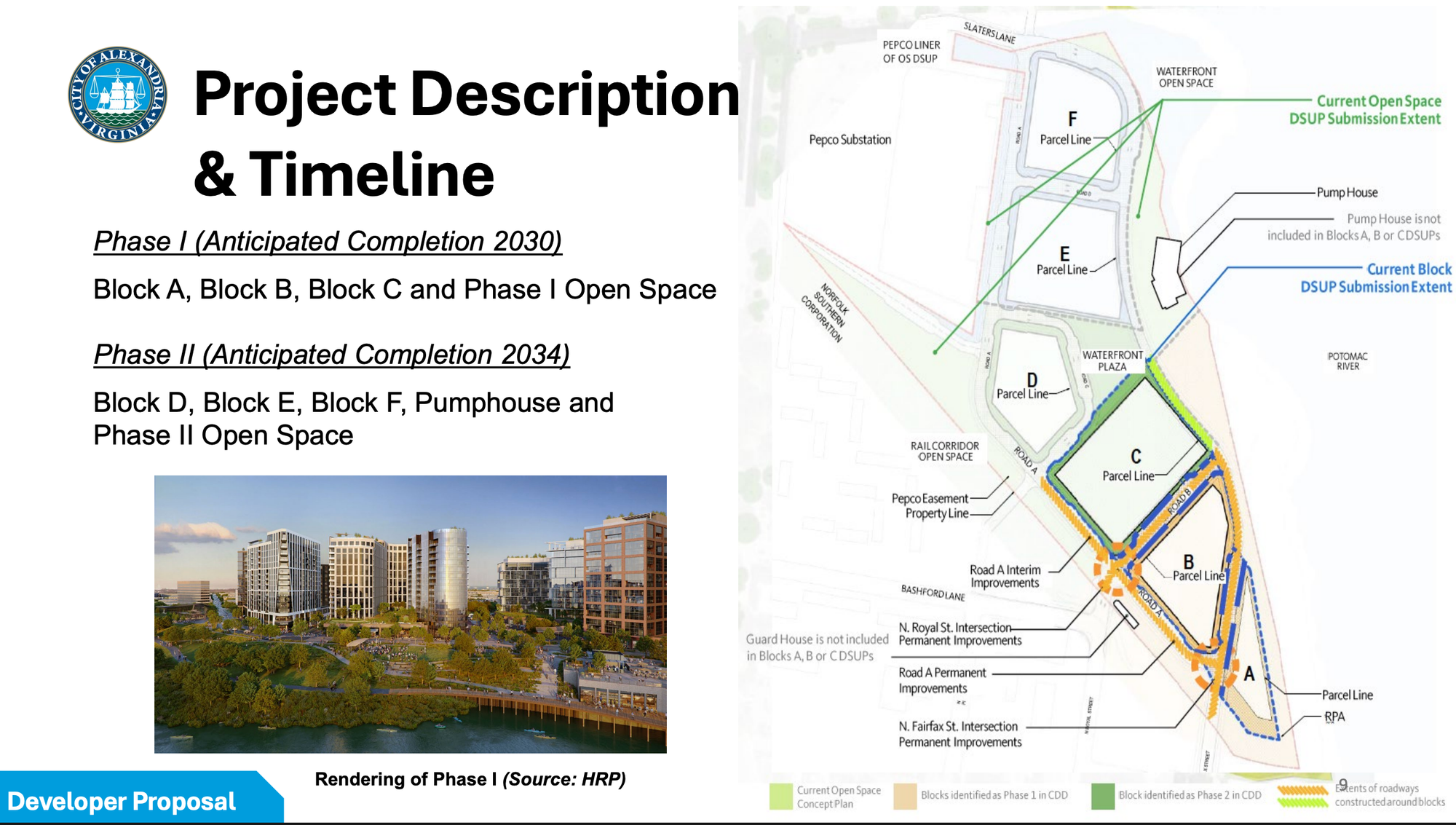
Phase I, anticipated for completion in 2030, includes Blocks A, B, and C plus Phase I open space, though the Development Special Use Permit submission currently before the city covers only Blocks B and C and the two parks. Block B will include 315 residential units and 70,000 square feet of ground-floor retail. Block C will house 500 units and 40,000 square feet of retail. Both Phase I buildings will rise approximately 172 feet — 16 stories — with all parking located below grade.
Phase II, anticipated for completion in 2034, includes Blocks D, E, and F, the Pumphouse, and Phase II open space.
The project would commence Phase I construction by Dec. 31, 2027, with hard ceilings on extensions: commencement no later than Dec. 31, 2029, and completion no later than Dec. 31, 2032. Phase II must commence by Dec. 31, 2030, with parallel hard ceilings.
The development is designed to deliver more than five acres of publicly accessible on-site open space, including a waterfront park and a linear "rail corridor" park along the city-facing edge of the property. HRP has committed to working with the National Park Service to remove the chain-link fence currently separating the Mount Vernon Trail from the river. A Dutch-style "woonerf" pedestrian-priority street is planned, along with four new DASH bus stops connecting the site to Potomac Yard and Braddock Road Metro stations.
The CDD-approved plan includes a minimum of 30,000 square feet of dedicated arts and cultural space and 15,000 square feet of subsidized below-market arts space planned for Block A.
Parajon noted that off-site improvements driven by the project would add another $80 million to $100 million in value beyond the $135 million in TIF-supported infrastructure. "Of our 135, the bulk of that is going to public infrastructure improvements, including parks and open space and amenities that the entire community can benefit from," he said.
Affordable housing
HRP's affordable housing commitment comes in three forms: approximately 60 on-site affordable units distributed across all residential phases, a financial contribution to the city's Housing Trust Fund, and a public-private partnership to construct a dedicated 100-unit affordable building of approximately 100,000 square feet in Phase II — for a total of approximately 160 affordable units.
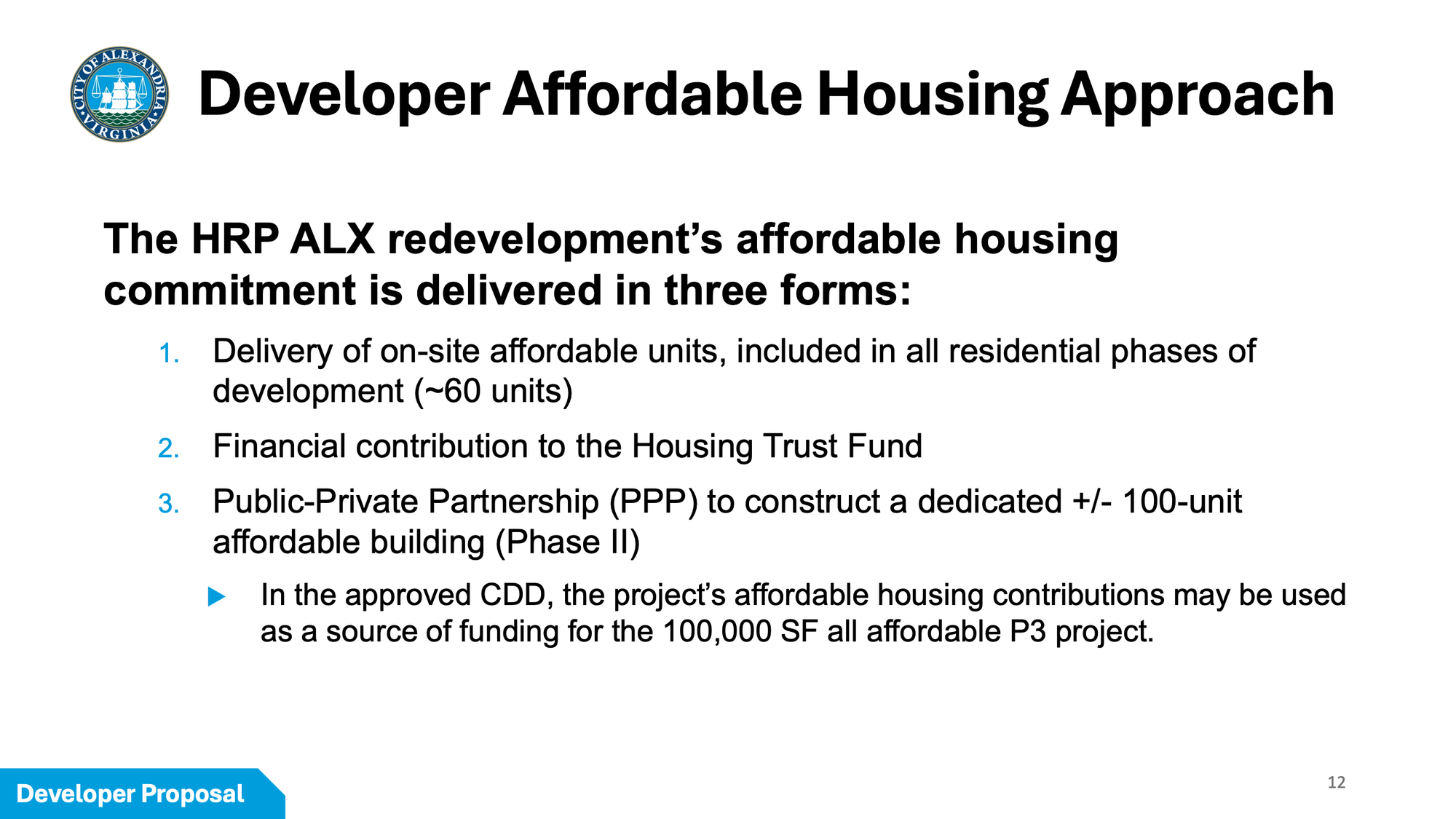
Councilwoman Jacinta Greene asked whether any of the affordable units would arrive in Phase I. Gonzalez said about 19 units of the 60 distributed on-site units would be included in Phase I, in Blocks B and C. The 100-unit affordable building is targeted for Phase II.
"We have what we have created here, which is in the summary term sheet, it's a pathway to creating that affordable housing project with a no later than date," Brown said. The Housing Trust Fund contribution and any escalation must be applied by 2034, with the city manager able to grant limited extensions for good-faith progress.
What happens if the project falters
Greene also asked Brown to clarify what protections the city has if HRP fails to perform.
"The developer will be responsible for all the costs up front, put in the infrastructure and then there'll be progress payment reimbursement from the bond proceeds," Brown said. "So we'll be able to inspect and verify that the work is being done pursuant to all of our plans and specs with the city."
Brown said the two-phase structure itself is a protection. "The term sheet, as written, does not obligate the city to move forward with Phase II if the performance milestones for Phase I are not met. So that's one important tool, is we have sort of the optionality to not go the full 135, but to stop at Phase I."
Councilman John Taylor Chapman, joining the meeting virtually, pressed for more on the same point. "What does the project look like if we stop at that point?"
"Phase I would include Block A, Block B, Block C and a portion of the open space and the site remediation. So it's pretty balanced between Phase I and Phase II," Parajon replied. "That would not be an ideal scenario, frankly, if we did one phase and left the other. I think if Phase I is successful, Phase II will move forward easily given the investment that the developer would put into the project."
Chapman also asked about external risks. "Are there any major changes to the economic landscape that we need to be mindful of as we look at this particular deal?" he asked. "If rates change ridiculously, if things in the White House, policy-wise, change in a particular area — is there threat of really changing the dynamics of what can be done here?"
Parajon acknowledged the question. "I think that's one of the reasons that we're bringing this forward to the council now is to try to — we know the current state, at least the short-term current state, as it relates to interest rates," he said. "I think the market gets uncertain later in the year and later in the federal administration term, frankly."
He said supply chains, construction costs and labor markets were the main variables to watch, but added that HRP's experience worked in the city's favor. "The good news is this is a very experienced developer that knows what they're doing and works in very large cities as well. So their ability to manage that is probably more nimble than a small company that does not have that capacity."
More City Council reaction
Vice Mayor Sarah Bagley spoke first and used her time to praise the framework rather than ask questions.
"I want to commend HRP. I mean, they are like — they're oddly, nothing having been built yet, they already sort of feel like a part of the community in Old Town North because they're present, I feel like, at so many events," Bagley said. "What I really want to applaud here, between city staff and everybody who worked on this, is we're finding a way to keep this moving. Because those 1,000 housing units are needed yesterday, and if we wait five years, 10 years, until — they'll only be more needed and more expensive when they arrive."
Bagley said the absence of an alternative path was conspicuous. "What I didn't hear really in Ms. Landrum's presentation was, well, or we wait three years, or we have a backup. I mean, I say that not critically, but I didn't hear sort of the backup. So I support the plan."
Councilman Canek Aguirre was brief. "I'm very excited for this project to be seen and move forward. So full steam ahead."
Mayor Alyia Gaskins closed the discussion with a longer reflection. "It's the community that came together to fight to take down the plant. It's the community that came together to shape the Old Town North small area plan. It's a community that's been working with HRP in order to design what this would look like and how do you bring that vision to reality. It's a community that came to multiple public hearings and everything for the rezoning. It's a community that came together for ALX Forward."
Gaskins pointed to the Landmark Mall redevelopment as a comparable success. "I think a perfect example I get to drive by on the other side of the city every day is what is happening at Landmark and watching kind of the power of what happens when you do leverage community feedback, community engagement, partnerships and creative tools to move things forward."
No member of city Council voiced opposition Tuesday night.
Process and timeline
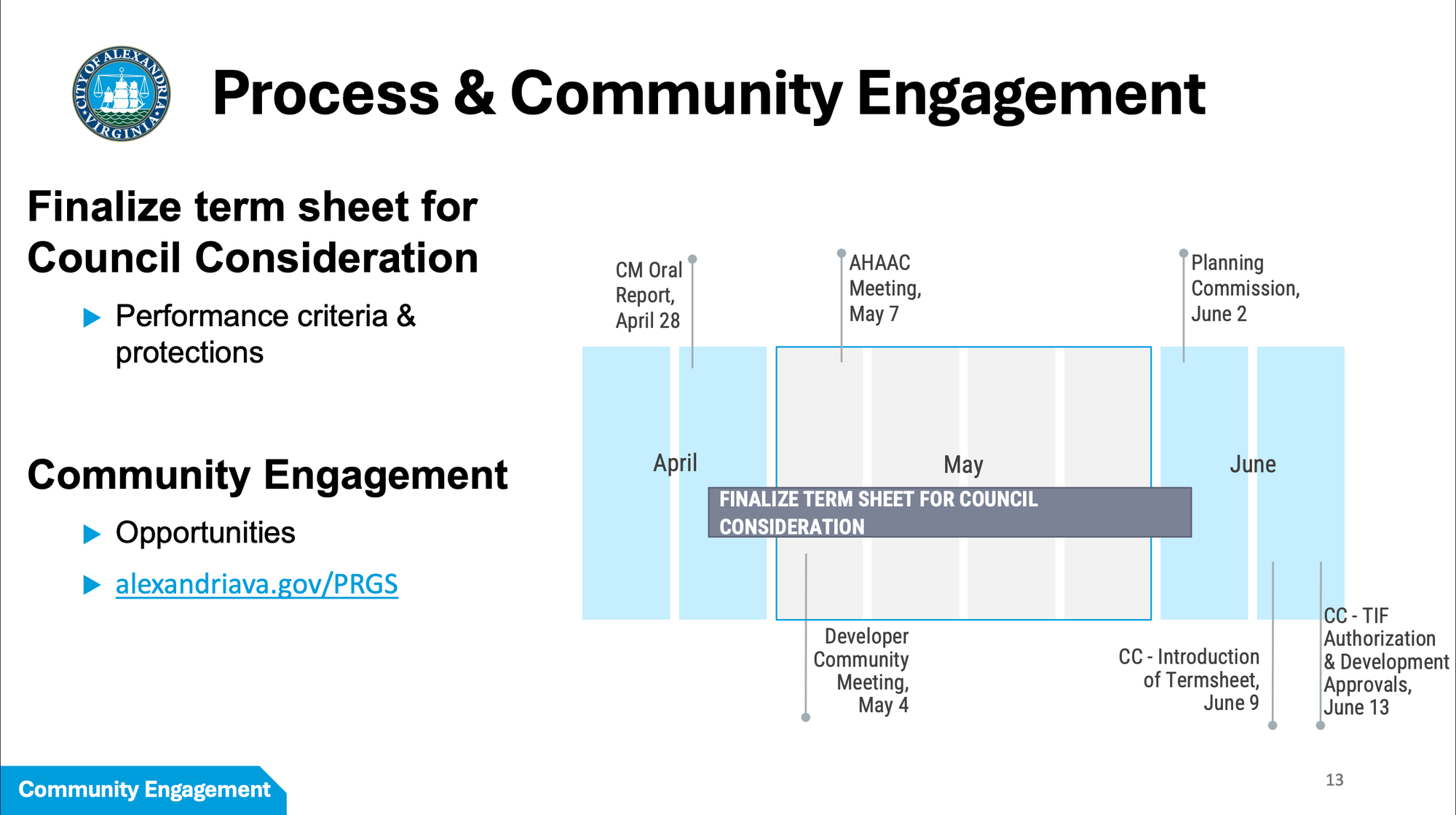
The remaining engagement and decision steps:
May 4 — HRP Group developer community meeting, virtual, 6 to 7 p.m.
May 7 — Alexandria Housing Affordability Advisory Committee meeting, virtual, 7 p.m.
June 2 — Planning Commission hearing on Phase I development approvals
June 9 — City Council introduction of the term sheet
June 13 — Saturday public hearing and council votes on TIF authorization, development and performance agreements, and Phase I development approvals
Public comments may be submitted at engage.alexandriava.gov/prgs or by emailing the City Clerk at CouncilComment@alexandriava.gov. The full term sheet outline and project details are at alexandriava.gov/PRGS.
Editor's note: This story was updated April 29 to further clarify that no existing Alexandria tax revenue would be used to pay debt service on the proposed bonds.